Treasure of the East
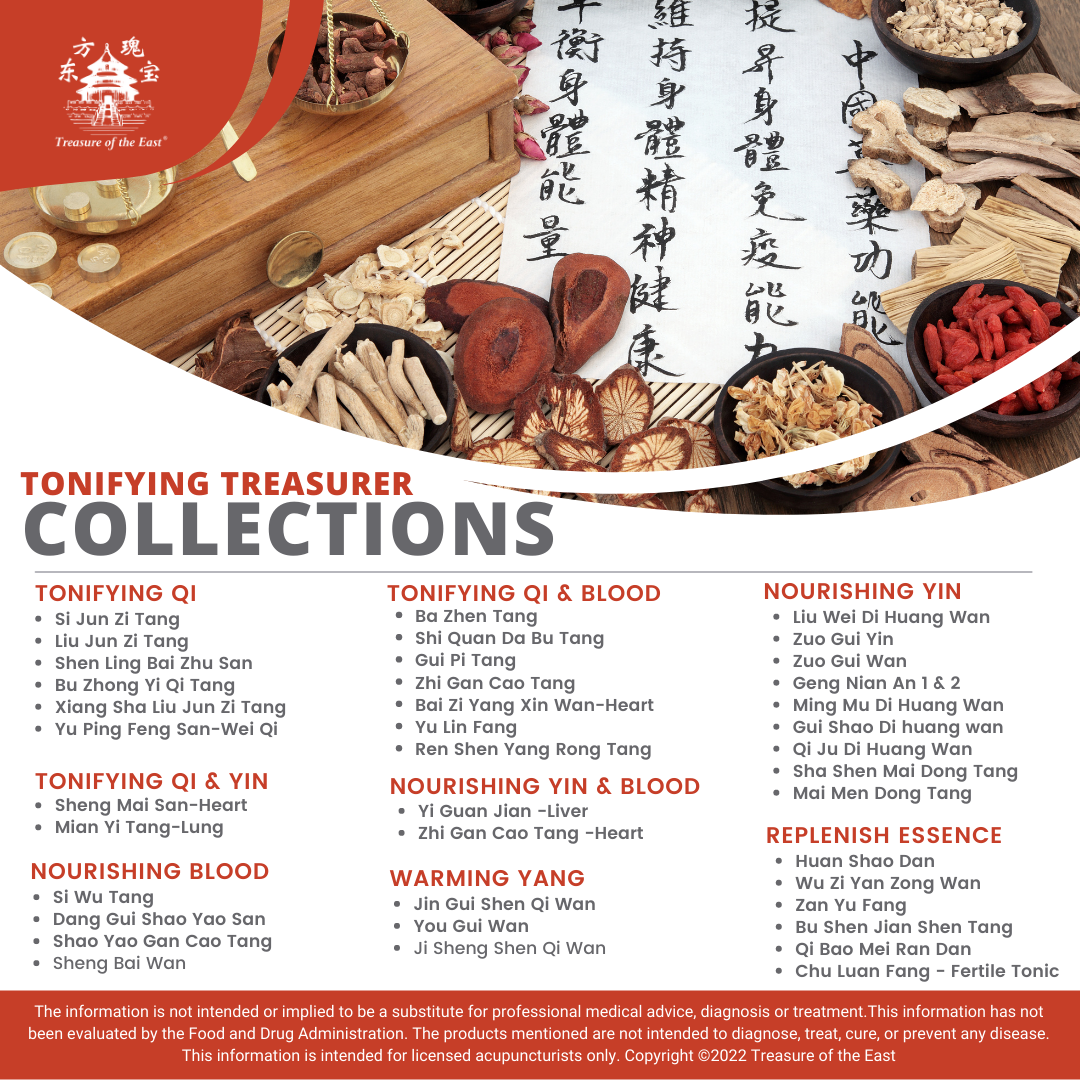
Zuo Gui Yin - 左归饮 - Left-Return Decoction (Capsules)
Zuo Gui Yin - 左归饮 - Left-Return Decoction (Capsules)
Couldn't load pickup availability
Not sure this is your formula?
Most people who search a formula name are guessing. Chorus Premium pairs you with a team of Chinese medicine practitioners and a PhD pharmacologist who match the formula to you, check it against your medications, and adjust it as you change.
Full-spectrum, water-based herbal extract; concentrated 5:1 capsules (100 caps./bottle).
Item Number: Z115-c
Chinese Name: 左归饮, Zuo Gui Yin
English Name: Left-Return Decoction
Formula Principles:
Enriches kidney Yin, supplements essence, and boosts marrow
Ingredients:
| Shu Di Huang | Rehmannia Root (Processed) |
| Shan Yao | Dioscorea Rhizome |
| Gou Qi Zi | Goji Berry |
| Shan Zhu Yu/Shan Yu Rou | Cornus Fruit (Processed) |
| Fu Ling | Poria Mushroom |
| Gan Cao (Mi) |
Licorice (Honey-Processed) |
TCM Pattern:
Kidney Jing insufficiency, emptiness of essence and marrow due to liver and kidney Yin deficiency, atrophy disorder due to liver and kidney deficiency
Also available as Granules.
Classical source
Classical source
Zuo Gui Yin was composed by Zhang Jingyue (Zhang Jiebin) and recorded in his Jing Yue Quan Shu (The Complete Works of Jingyue), published in 1624 in the late Ming dynasty. Zhang wrote it for what he called insufficiency of true yin: Kidney yin and essence that have run low, with an aching lower back, night sweating, a dry mouth and throat, and thirst. He designed it as a pure tonic that builds without draining. Zuo, left, refers to the left Kidney, which classical theory linked with yin and water. Gui means to return, and yin here means a drink, a formula taken as a decoction.
The pattern
The pattern
The pattern is Kidney yin deficiency with depleted essence (shen yin xu, shen jing bu zu). In Chinese medicine the Kidney stores the body's deepest reserves: the yin that cools and moistens, and the essence that underpins bone, hearing, memory and resilience. When age, long illness, overwork or late nights spend these reserves, the picture is one of slow drying out. The lower back and knees ache and feel weak. There may be dizziness, ringing in the ears, a dry mouth and throat, mild night sweats and thirst. The tongue is pinkish to red with little coat, and the pulse is thin. Rest helps; overwork and late nights make it worse. Strong afternoon heat, flushed cheeks and a rapid pulse point to deficiency fire, which needs a formula that also clears heat.
How it works in Chinese medicine
How it works in Chinese medicine
The treatment principle is to enrich Kidney yin and replenish essence. Prepared rehmannia is the chief, a rich tonic of yin, blood and essence. Cornus fruit and goji berry are the deputies, nourishing the Liver and Kidney together, since Liver blood and Kidney essence share a source; cornus also helps hold in what is being restored. Chinese yam strengthens the Spleen and Kidney, and poria keeps the Spleen working so that the rich tonics are digested rather than sitting heavily. Honey-fried licorice harmonises the formula and supports the Middle. Zuo Gui Yin builds rather than drains, which suits depletion without much heat or damp.
Ingredients
Ingredients
- Shu Di Huang: Rehmannia root, prepared
- Shan Yao: Chinese yam (dioscorea rhizome)
- Gou Qi Zi: Goji berry
- Shan Zhu Yu: Cornus fruit, processed
- Fu Ling: Poria
- Gan Cao (mi): Licorice root, honey-fried
Six plant ingredients, with no animal or mineral substances. It contains honey-fried licorice root.
How to use
How to use
The capsules are a 5:1 full-spectrum water extract, 100 capsules per bottle. Follow the label or your practitioner for how much to take.
If you are pregnant, nursing, taking medication or managing a health condition, speak with your practitioner before use. Educational information only; these statements have not been evaluated by the FDA and this product is not intended to diagnose, treat, cure or prevent any disease.
In biomedical terms
In biomedical terms
In TCM terms this is a slow drying out of the body's deepest reserves. Research interprets it mainly as nitric oxide in the wrong place: too much from the inflammatory enzyme, too little where tissue is built and repaired. In a study of 156 men with erectile dysfunction grouped by Chinese medicine pattern, those with Kidney yin deficiency had higher serum levels of the inflammatory nitric oxide enzyme (iNOS) than those without Kidney deficiency or with Kidney yang deficiency, and higher cortisol than those without Kidney deficiency [1]. For night heat, blocking nitric oxide in the skin of postmenopausal women blunted the rise in skin blood flow during hot flushes [2]. In bone from people with low bone density, the Kidney yin deficiency pattern showed inflammatory NF-kB, TNF and IL-17 signalling and cellular stress, with loss of the BMP and Wnt bone-building pathways [3]. Hydrogen sulfide is the other half of the picture: in studies, oestrogen loss lowered blood hydrogen sulfide and the enzymes that make it in bone marrow, and a hydrogen sulfide donor restored bone formation [4]. A review describes hydrogen sulfide as a mediator of healthy ageing across species [5].
On the formula side, in studies Zuo Gui Yin raised nitric oxide production and nitric oxide synthase activity in ageing ovaries [6], and in studies of ageing it lowered oxidative and inflammatory markers and raised antioxidant enzymes in the liver and kidney [7]. Among its herbs, steamed prepared rehmannia raised Bifidobacterium alongside its yin-nourishing effects [8], goji polysaccharide raised Butyricicoccus, Lactobacillus and Akkermansia [9], Chinese yam raised Bifidobacteria and Lactobacilli and short-chain fatty acids [10], the rehmannia and cornus pair raised butyrate-producing Clostridiaceae and butyrate [11], and poria lowered the sulfide-producing bacterium Bilophila [12].
Questions and answers
Questions and answers
What is Zuo Gui Yin used for in Chinese medicine?
Zuo Gui Yin is a classical formula traditionally used for Kidney yin deficiency with depleted essence: an aching, weak lower back and knees, dizziness, ringing in the ears, a dry mouth and throat, mild night sweats and thirst, often after long overwork, illness or with age. It enriches yin and replenishes essence without draining, so it suits depletion without much heat or damp. A practitioner usually confirms the pattern before recommending it.
What pattern is Zuo Gui Yin for?
Kidney yin deficiency with depleted essence (shen yin xu, shen jing bu zu). The Kidney's cooling, moistening reserves and its essence have run low. Typical signs are a pinkish to red tongue with little coat and a thin pulse. Strong afternoon heat and flushed cheeks suggest deficiency fire, which calls for a formula that also clears heat; cold limbs and a pale, swollen tongue suggest Kidney yang deficiency instead.
How does Zuo Gui Yin work?
In Chinese medicine terms it enriches Kidney yin and essence with prepared rehmannia, cornus and goji, while Chinese yam and poria keep digestion working so the tonics are absorbed. In biomedical terms, research links the pattern to inflammatory nitric oxide running high [1] and to low hydrogen sulfide where bone is built [4]. In studies the formula lowered oxidative and inflammatory markers in the liver and kidney [7], and its herbs raised Bifidobacteria, Lactobacilli and short-chain fatty acids [10].
What is the difference between Zuo Gui Yin and Liu Wei Di Huang Wan?
Both enrich Kidney yin around prepared rehmannia, cornus and Chinese yam. Liu Wei Di Huang Wan pairs three tonics with three herbs that drain damp and clear heat, so it suits yin deficiency with some heat or damp. Zuo Gui Yin leaves out alisma and moutan, keeps poria, and adds goji berry and honey-fried licorice, so it builds rather than drains. Practitioners use it when depletion of yin and essence is the main problem.
What is the difference between Zuo Gui Yin capsules and granules?
Both are 5:1 full-spectrum water extracts of the same six herbs from the same maker. The granules dissolve in hot water and are drunk as a tea, which makes the amount easy for a practitioner to adjust. The capsules hold the same kind of extract in a portable, tasteless form. Follow the label or your practitioner for how much to take.
Who should not take Zuo Gui Yin?
Check with a practitioner first if you are pregnant or breastfeeding or take regular medication. Traditionally the formula is not used when digestion is weak with loose stools, bloating and a thick greasy tongue coat, since rich tonics can sit heavily, or during a cold or fever. Marked heat, such as strong flushing with a red face, usually calls for a formula that also clears heat.
References
References
- Wang R et al. (2020). [Blood biochemical indexes in ED patients with kidney deficiency or non-kidney deficiency: A comparative analysis of 156 cases]. Zhonghua Nan Ke Xue. PubMed
- Hubing KA et al. (2010). Nitric oxide synthase inhibition attenuates cutaneous vasodilation during postmenopausal hot flash episodes. Menopause. PubMed
- Cui J et al. (2026). Single-cell transcriptomic atlas of Kidney-Yang and Kidney-Yin deficiency syndromes reveals distinct osteoimmune-stromal programs underlying osteopenia and osteoporosis. MedScience. PubMed
- Grassi F et al. (2016). Hydrogen Sulfide Is a Novel Regulator of Bone Formation Implicated in the Bone Loss Induced by Estrogen Deficiency. J Bone Miner Res. PubMed
- Wilkie SE et al. (2021). Hydrogen sulfide in ageing, longevity and disease. Biochem J. PubMed
- Zhao W et al. (2012). [Effects and mechanisms of zuogulyin on the ovarian NO production in peri-menopausal rats]. Zhongguo Zhong Xi Yi Jie He Za Zhi. PubMed
- Xie J et al. (2025). The mechanism underlying of Zuoguiyin on liver and kidney in D-gal-induced subacute aging female rats: A perspective on SIRT1-PPARγ pathway regulation of oxidative stress, inflammation and apoptosis. J Ethnopharmacol. PubMed
- Zhang XY et al. (2023). Comparing steamed and wine-stewed Rehmanniae Radix in terms of Yin-nourishing effects via metabolomics and microbiome analysis. J Ethnopharmacol. PubMed
- Li ZY et al. (2023). Lycium barbarum polysaccharide alleviates DSS-induced chronic ulcerative colitis by restoring intestinal barrier function and modulating gut microbiota. Ann Med. PubMed
- Zhang N et al. (2019). Chinese yam (Dioscorea opposita Thunb.) alleviates antibiotic-associated diarrhea, modifies intestinal microbiota, and increases the level of short-chain fatty acids in mice. Food Res Int. PubMed
- Chen Y et al. (2022). The Herb Pair Radix Rehmanniae and Cornus Officinalis Attenuated Testicular Damage in Mice With Diabetes Mellitus Through Butyric Acid/Glucagon-Like Peptide-1/Glucagon-Like Peptide-1 Receptor Pathway Mediated by Gut Microbiota. Front Microbiol. PubMed
- Zhou X et al. (2025). Regulatory effects of Poria cocos polysaccharides on gut microbiota and metabolites: evaluation of prebiotic potential. NPJ Sci Food. PubMed
Share