Treasure of the East
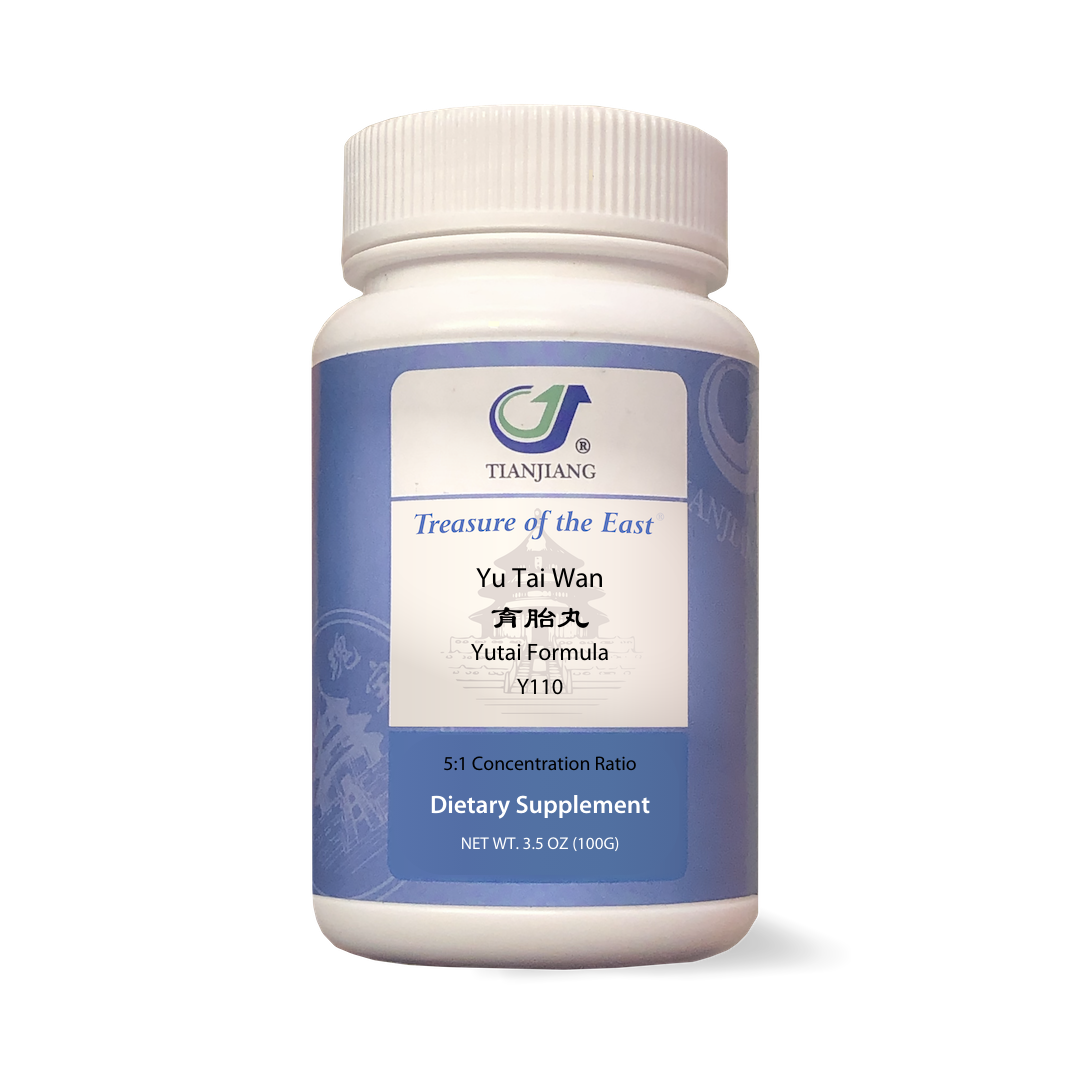
Yu Tai Wan - 育胎丸 - Yutai Formula (Granules)
Yu Tai Wan - 育胎丸 - Yutai Formula (Granules)
Couldn't load pickup availability
Not sure this is your formula?
Most people who search a formula name are guessing. Chorus Premium pairs you with a team of Chinese medicine practitioners and a PhD pharmacologist who match the formula to you, check it against your medications, and adjust it as you change.
Full-spectrum, water-based herbal extract; concentrated 5:1 granules (100g/bottle).
Chinese Name: 育胎丸, Yu Tai Wan
Alternate Name: Zi Shen Yu Tai Wan
English Name: Yutai Formula
Item Number: Y110
Formula Principles:
- Tonify the kidneys and spleen
- Replenish qi and nourish the vitality
- Nourish blood and calm the fetus
- Strengthen and stabilizes the kidneys
Ingredients:
| Tu Si Zi (Yan Zhi) | Dodder Seed |
| Shu Di Huang | Processed Rehmannia Root |
| Sang Ji Sheng | Mistletoe Herb |
| Gou Qi Zi | Goji Berry |
| Xu Duan | Dipsacus Root |
| Du Zhong (Yan) | Processed Eucommia Bark |
| E Jiao | Equus Asinus Gelatin |
| Ba Ji Tian | Morinda Root |
| Bai Zhu (Chao) | Processed White Atractylodes Rhizome* |
| Dang Shen | Codonopsis Root |
| He Shou Wu (Zhi) | Processed Flowery Knotweed Root |
| Ai Ye | Mugwort Leaf |
| Lu Jiao Shuang | Degelinated Antler |
| Sha Ren | Amomum Fruit |
*May contain wheat - processed with bran.
TCM Pattern:
- Deficiency of kidneys and spleen
- Unconsolidation of Chong Ren and conception channels
Dosage
Mix 4.5 g in hot water and drink as tea, 2-3 daily.
*The information provided here is for healthcare professional practitioners only. These statements have not been evaluated by the Food and Drug Administration. This product is not intended to diagnose, treat, cure or prevent any disease.
Classical source
Classical source
Yu Tai Wan, also called Zi Shen Yu Tai Wan, is a modern formula from twentieth-century Chinese gynaecology, without a single classical source. Its core is Shou Tai Wan, a four-herb pill recorded by Zhang Xichun in Yi Xue Zhong Zhong Can Xi Lu (Records of Heart-Felt Experiences in Medicine with Reference to the West) in the first decades of the twentieth century: dodder seed, Chinese taxillus, dipsacus and donkey-hide gelatin, which tonify and secure the Kidney. To this core it adds herbs that nourish blood and essence, warm Kidney yang and strengthen the Spleen. The name begins with zi shen, to enrich the Kidney.
The pattern
The pattern
The pattern is Kidney and Spleen deficiency with the Chong and Ren vessels insecure (shen pi liang xu, chong ren bu gu). In Chinese medicine the Kidney stores essence and holds things in place, the Spleen makes qi and blood and lifts, and the Chong and Ren vessels draw on both. When both organs are weak, the body loses its holding power. The lower back aches and feels weak, often with a heavy, dragging feeling in the lower abdomen. There is tiredness, poor appetite, loose stools, dizziness and frequent, clear urination. The face is pale. The tongue is pale with a thin white coat, and the pulse is deep, thin and weak at the Kidney position. Overwork makes it worse. Heat, a red tongue or restlessness point to a different pattern.
How it works in Chinese medicine
How it works in Chinese medicine
The treatment principle is to tonify the Kidney and Spleen, secure the Chong and Ren vessels and nourish blood. Dodder seed is the chief, tonifying both Kidney yin and yang and securing what the Kidney holds. Chinese taxillus, dipsacus and eucommia are the deputies, strengthening the Kidney and lower back. Prepared rehmannia, goji berry, prepared fleeceflower root and donkey-hide gelatin nourish blood and essence, while morinda and degelatinated deer antler gently warm Kidney yang. Codonopsis and white atractylodes strengthen the Spleen so the formula is digested and qi can lift. Mugwort leaf warms the lower abdomen, and amomum keeps the rich tonics from weighing on digestion. The design secures and builds rather than moves.
Ingredients
Ingredients
- Tu Si Zi (yan zhi): Dodder seed, salt-processed
- Shu Di Huang: Rehmannia root, prepared
- Sang Ji Sheng: Chinese taxillus (mistletoe) twig
- Gou Qi Zi: Goji berry
- Xu Duan: Dipsacus root
- Du Zhong (yan zhi): Eucommia bark, salt-processed
- E Jiao: Donkey-hide gelatin
- Ba Ji Tian: Morinda root
- Bai Zhu (chao): White atractylodes rhizome, fried with bran
- Dang Shen: Codonopsis root
- He Shou Wu (zhi): Fleeceflower root, prepared
- Ai Ye: Mugwort leaf
- Lu Jiao Shuang: Degelatinated deer antler
- Sha Ren: Amomum fruit
Fourteen ingredients: twelve plant ingredients and two animal substances, donkey-hide gelatin (E Jiao) and degelatinated deer antler (Lu Jiao Shuang). The white atractylodes is fried with wheat bran, and the Treasure of the East label states the product may contain wheat, so it is not suitable for anyone with celiac disease.
How to use
How to use
The granules are a 5:1 full-spectrum water extract, 100 g per bottle, mixed into hot water and drunk as a tea. Mix 4.5 g in hot water and drink as tea, 2-3 daily, or as directed by your practitioner.
If you are pregnant, nursing, taking medication or managing a health condition, speak with your practitioner before use. Educational information only; these statements have not been evaluated by the FDA and this product is not intended to diagnose, treat, cure or prevent any disease.
In biomedical terms
In biomedical terms
In TCM terms this is a pattern of weak holding: the Kidney cannot keep things secure and the Spleen cannot lift. Research interprets it as fading nitric oxide signalling in the muscles that hold and release, and cells short of energy. For frequent urination, in studies ageing lowered nerve nitric oxide synthase, its messenger cGMP and relaxation in the urethra, with more unstable bladder contractions [1], and four weeks of blocking nitric oxide synthase raised bladder contraction frequency and the volume left after voiding [2]. For tiredness, poor appetite and loose stools, in studies Spleen qi deficiency lowered energy (ATP) in the lining of the gut, with fewer mitochondria and shorter villi [3]. For the aching lower back, hydrogen sulfide supports bone building: in studies, oestrogen loss lowered blood hydrogen sulfide and the enzymes that make it in bone marrow, and a hydrogen sulfide donor restored bone formation [4].
On the formula side, among its herbs akebia saponin D, the main compound of dipsacus, raised Bifidobacterium, Butyricimonas and Ruminococcus [5]. Whole goji berry raised Bacteroides and Parabacteroides and was fermented to short-chain fatty acids [6]. Morinda oligosaccharides raised 5-hydroxytryptophan made by gut bacteria, which reached the brain and raised serotonin there [7]. Codonopsis fructan stimulated Faecalibacterium, Prevotella and Bifidobacterium [8], and amomum volatile oil lowered harmful bacteria and raised beneficial ones [9].
Questions and answers
Questions and answers
What is Yu Tai Wan used for in Chinese medicine?
Yu Tai Wan, also called Zi Shen Yu Tai Wan, is a modern formula traditionally used for Kidney and Spleen deficiency with the Chong and Ren vessels insecure: an aching, weak lower back, a heavy, dragging feeling low in the abdomen, tiredness, poor appetite and frequent, clear urination. It tonifies and secures the Kidney, nourishes blood and strengthens the Spleen. A practitioner usually confirms the pattern before recommending it.
What pattern is Yu Tai Wan for?
Kidney and Spleen deficiency with the Chong and Ren vessels insecure (shen pi liang xu, chong ren bu gu). The Kidney cannot hold securely and the Spleen cannot lift. Typical signs are a pale tongue with a thin white coat and a deep, thin pulse that is weak at the Kidney position. A red tongue, heat or restlessness point to a different pattern that needs cooling rather than warming.
How does Yu Tai Wan work?
In Chinese medicine terms it secures the Kidney with dodder seed, Chinese taxillus, dipsacus and eucommia, nourishes blood with rehmannia, goji and donkey-hide gelatin, and strengthens the Spleen with codonopsis and white atractylodes. In biomedical terms, research links the pattern to fading nitric oxide signalling in the muscles that hold and release [1] and to low energy in the gut lining [3]. Among its herbs, dipsacus raised Bifidobacterium [5].
How is Yu Tai Wan different from Yu Lin Fang?
Both tonify the Kidney and nourish blood. Yu Lin Fang builds on Ba Zhen Tang, the eight-herb qi and blood formula, and warms the lower body, so it suits late, scanty cycles with cold. Yu Tai Wan centres on dodder seed and herbs that secure the Kidney, so practitioners use it when the main problem is weak holding: a dragging feeling, an aching lower back and frequent urination.
Who should not take Yu Tai Wan?
If you are pregnant or trying to conceive, check with your practitioner first. It is not suitable for anyone with celiac disease, since the label states it may contain wheat. It contains donkey-hide gelatin and deer antler, so it does not suit a vegan diet. Traditionally it is not used when digestion is blocked, with a thick greasy tongue coat, or during a cold or fever.
How long does Yu Tai Wan take to work?
In Chinese medicine, Kidney strength and holding power are rebuilt slowly, so practitioners usually judge a securing, building formula like this over weeks rather than days, watching the lower back, energy and urination. If nothing has shifted after several weeks, it is worth asking whether the pattern was the right match.
References
References
- Gotoh D et al. (2023). Impaired nitric oxide mechanisms underlying lower urinary tract dysfunction in aging rats. Am J Physiol Renal Physiol. PubMed
- Noguchi K et al. (2019). Evaluation of a rat model of functional urinary bladder outlet obstruction produced by chronic inhibition of nitric oxide synthase. Life Sci. PubMed
- Zhang T et al. (2025). [Effect and mechanism of Liujunzi Pills on gut microbiota of rats with spleen Qi deficiency syndrome]. Zhongguo Zhong Yao Za Zhi. PubMed
- Grassi F et al. (2016). Hydrogen Sulfide Is a Novel Regulator of Bone Formation Implicated in the Bone Loss Induced by Estrogen Deficiency. J Bone Miner Res. PubMed
- Yang S et al. (2021). Akebia saponin D ameliorates metabolic syndrome (MetS) via remodeling gut microbiota and attenuating intestinal barrier injury. Biomed Pharmacother. PubMed
- Wang J et al. (2024). In vitro digestion and fermentation of the whole goji berry: Bioactive ingredients change and impacts on human gut microbiota. J Food Sci. PubMed
- Zhang ZW et al. (2022). Morinda officinalis oligosaccharides increase serotonin in the brain and ameliorate depression via promoting 5-hydroxytryptophan production in the gut microbiota. Acta Pharm Sin B. PubMed
- Li J et al. (2024). Modulation of Human Gut Microbiota In Vitro by Inulin-Type Fructan from Codonopsis pilosula Roots. Indian J Microbiol. PubMed
- Zhang T et al. (2017). Volatile Oil from Amomi Fructus Attenuates 5-Fluorouracil-Induced Intestinal Mucositis. Front Pharmacol. PubMed
Share