Treasure of the East
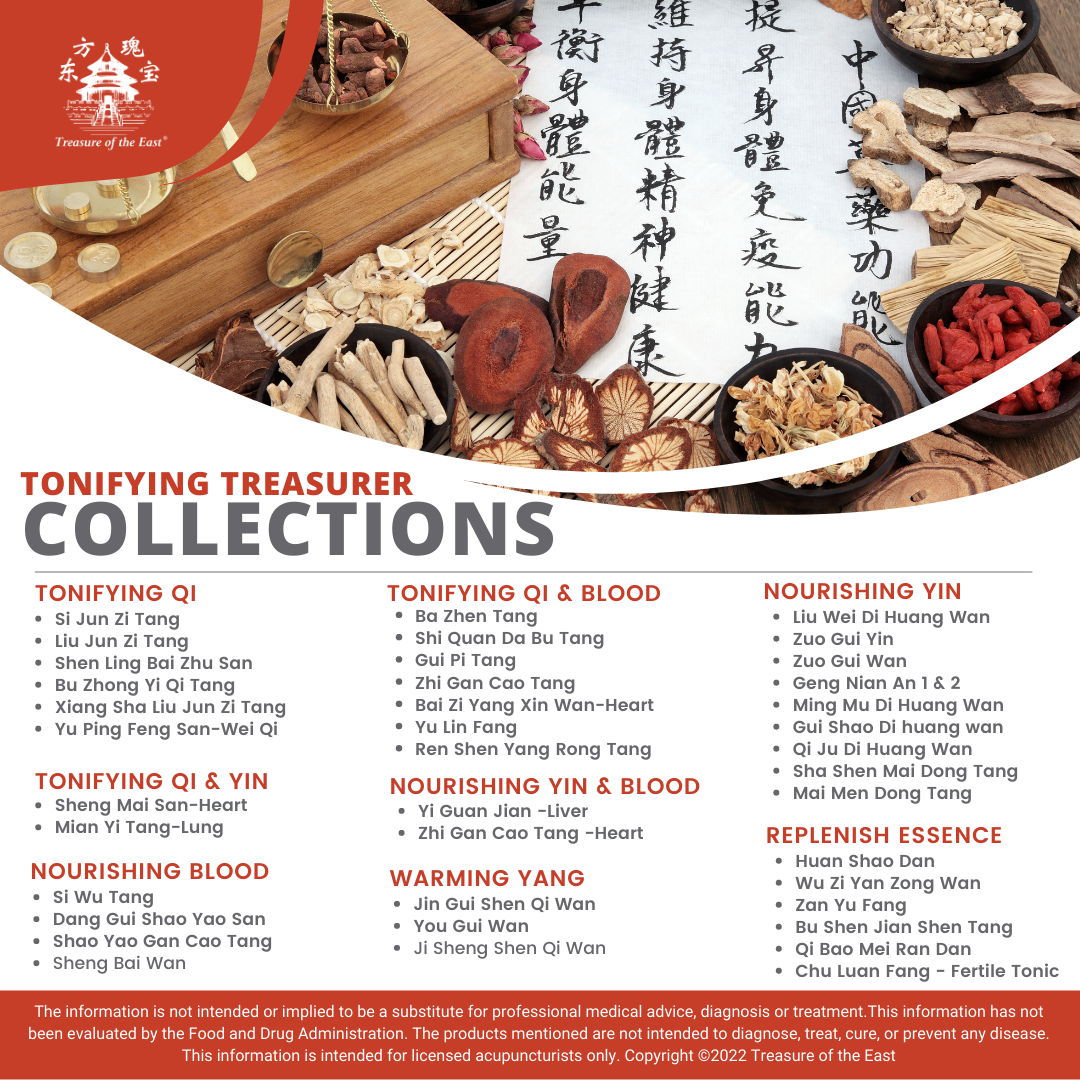
Qi Bao Mei Ran Dan - 七宝美髯丹 - Seven Treasures Formula (Granules)
Qi Bao Mei Ran Dan - 七宝美髯丹 - Seven Treasures Formula (Granules)
Couldn't load pickup availability
Not sure this is your formula?
Most people who search a formula name are guessing. Chorus Premium pairs you with a team of Chinese medicine practitioners and a PhD pharmacologist who match the formula to you, check it against your medications, and adjust it as you change.
Full-spectrum, water-based herbal extract; concentrated 5:1 granules (100g/bottle).
Item Number: Q002
Chinese Name: 七宝美髯丹, Qi Bao Mei Ran Dan
English Name: Seven Treasures Formula
Formula Principles:
Enriches the kidney Jing, nourishes the liver blood, beautifies hair
Ingredients:
| He Shou Wu (Zhi) |
Flowery Knotweed Root (Processed) |
| Fu Ling | Poria |
| Niu Xi (Huai) | Achyranthes Root |
| Dang Gui |
Chinese Angelica Root |
| Gou Qi Zi | Goji Berry |
| Tu Si Zi (Yan Zhi) | Dodder Seed |
| Bu Gu Zhi (Yan Zhi) | Psoralea Fruit (Processed) |
TCM Pattern:
Gray or thin hair due to kidney Jing, and liver-blood deficiency
Dosage:
Mix 4.5 g in hot water and drink as tea, 2-3 daily.
Also available as Capsules.
Classical source
Classical source
Qi Bao Mei Ran Dan is recorded in Yi Fang Ji Jie (Analytic Collection of Medical Formulas), compiled by Wang Ang in 1682, early in the Qing dynasty. The formula is older. Tradition holds that the Daoist physician Shao Yuanjie presented it to the Ming Jiajing emperor in the sixteenth century, and that its reputation spread from the court. It was used for greying hair and beard, loosening teeth and weak knees in those whose Liver blood and Kidney essence had been depleted. Qi bao means seven treasures, its seven ingredients, and mei ran means a fine beard: the formula was meant to keep hair and beard dark and full.
The pattern
The pattern
The pattern is Liver and Kidney essence-blood deficiency (gan shen jing xue kui xu). The Kidney stores essence and the Liver stores blood, and in Chinese medicine the hair is the surplus of blood, with its root in essence. When both run low, hair greys early, thins or falls, and the beard loses its colour. The lower back and knees ache and feel weak, teeth may loosen, and there may be dizziness, ringing in the ears or blurred vision. Libido may fade. The tongue is pale with a thin coat and the pulse thin and weak. Overwork and late nights make it worse. Hair loss in patches with itching, or oily, inflamed skin, points to heat or wind in the blood instead, which is a different pattern.
How it works in Chinese medicine
How it works in Chinese medicine
The treatment principle is to nourish Liver blood and fill Kidney essence, with gentle support for Kidney yang. Processed fleeceflower root (He Shou Wu) is the chief: it nourishes blood and essence and is traditionally the herb for the hair. Goji berry and dodder seed support it as deputies, adding essence to the Liver and Kidney. Chinese angelica nourishes blood, achyranthes strengthens the lower back and knees and leads the formula downward, and psoralea warms Kidney yang so that the rich, yin-building herbs can be put to use. Poria is the envoy: it strengthens the Spleen and drains dampness, so that the tonics are digested well.
Ingredients
Ingredients
- He Shou Wu (Zhi): Fleeceflower root (flowery knotweed root), processed
- Fu Ling: Poria
- Niu Xi (Huai): Achyranthes root
- Dang Gui: Chinese angelica root
- Gou Qi Zi: Goji berry
- Tu Si Zi (Yan Zhi): Dodder seed, salt-processed
- Bu Gu Zhi (Yan Zhi): Psoralea fruit, processed
Seven plant ingredients, with no animal or mineral substances. The fleeceflower root is the processed form, and the dodder seed and psoralea fruit are processed with salt.
How to use
How to use
The granules are a 5:1 full-spectrum, water-based extract, 100 g per bottle. Mix 4.5 g in hot water and drink as a tea, two to three times daily, or as directed by your practitioner.
If you are pregnant, nursing, taking medication or managing a health condition, speak with your practitioner before use. Educational information only; these statements have not been evaluated by the FDA and this product is not intended to diagnose, treat, cure or prevent any disease.
In biomedical terms
In biomedical terms
In TCM terms, the hair, bones and senses are losing the blood and essence that nourish them. Research interprets this as oxidative stress and a waning of protective gases in small vessels and bone. In a study of 50 young people with premature greying, the blood showed more oxidative damage and lower antioxidant defences than in matched controls, and the more grey hairs, the greater the imbalance [1]. Capillary density and blood flow fall with age; in studies, restoring an endothelial ageing pathway rebuilt capillaries and endurance, and hydrogen sulfide strengthened the effect [2]. In bone, the hydrogen sulfide-making enzymes CBS and CSE were reduced in femur tissue from patients with osteoporosis [3], which fits the weak knees and loosening teeth of the pattern.
On the formula side, the chief herb's main compound, tetrahydroxystilbene glucoside (TSG), promoted hair regrowth by curbing programmed cell death in the skin [4], and in another study moved resting hair follicles into growth through Th22 immune cells [5]. In studies of colitis, TSG also raised Lachnospiraceae NK4A136, lowered Helicobacter, Bacteroides and Parabacteroides and restored the gut barrier [6]. Human gut Bacteroides broke down an achyranthes polysaccharide into acetate and propionate [7], psoralea polysaccharides raised Lactobacillus and Lachnospiraceae NK4A136 [8], and goji polysaccharide raised Butyricicoccus, Lactobacillus and Akkermansia [9].
Questions and answers
Questions and answers
What is Qi Bao Mei Ran Dan used for in Chinese medicine?
Qi Bao Mei Ran Dan is a classical formula traditionally used for Liver and Kidney essence-blood deficiency: hair and beard that grey early or thin, an aching, weak lower back and knees, loosening teeth, dizziness and ringing in the ears. It nourishes the blood and essence that Chinese medicine sees as the root of the hair. A practitioner usually confirms the pattern before recommending it.
What pattern is Qi Bao Mei Ran Dan for?
Liver and Kidney essence-blood deficiency (gan shen jing xue kui xu). Typical signs are early greying or thinning hair with weak knees and lower back, a pale tongue with a thin coat and a thin, weak pulse. Patchy hair loss with itching, or oily, inflamed skin, suggests heat or wind in the blood instead, which calls for a different formula.
How does Qi Bao Mei Ran Dan work?
In Chinese medicine terms, processed fleeceflower root, goji berry and dodder seed refill blood and essence, Chinese angelica and achyranthes carry them to the lower body, psoralea adds warmth and poria protects digestion. In biomedical terms, premature greying goes with oxidative stress [1]. In studies, TSG from fleeceflower root promoted hair regrowth [4] and rebalanced gut bacteria [6].
How is Qi Bao Mei Ran Dan different from He Shou Wu on its own?
Processed fleeceflower root (He Shou Wu) is the chief herb, but the formula surrounds it with six others. Goji berry and dodder seed add essence, Chinese angelica adds blood, achyranthes and psoralea strengthen the lower back and Kidney yang, and poria protects digestion. This balance is what makes it a formula for Liver and Kidney essence-blood deficiency rather than a single herb.
What is the difference between Qi Bao Mei Ran Dan capsules and granules?
Both are 5:1 full-spectrum water extracts of the same seven ingredients from the same maker. The granules dissolve in hot water and are drunk as a tea, which lets a practitioner adjust the amount or combine them with other granules. The capsules hold the same kind of extract in a portable, tasteless form. Follow the label or your practitioner for how much to take.
Who should not take Qi Bao Mei Ran Dan?
If you are pregnant or trying to conceive, check with your practitioner first. Check too if you take regular or blood-thinning medication. Traditionally it is not used when digestion is weak with loose stools or a heavy, greasy tongue coat, since the rich tonics are hard to digest, or during an acute illness with fever. Sudden or patchy hair loss is worth a medical assessment.
References
References
- Saxena S et al. (2020). Evaluation of Systemic Oxidative Stress in Patients with Premature Canities and Correlation of Severity of Hair Graying with the Degree of Redox Imbalance. Int J Trichology. PubMed
- Das A et al. (2018). Impairment of an Endothelial NAD+-H2S Signaling Network Is a Reversible Cause of Vascular Aging. Cell. PubMed
- Hao YM et al. (2021). Association of Hydrogen Sulfide with Femoral Bone Mineral Density in Osteoporosis Patients: A Preliminary Study. Med Sci Monit. PubMed
- Chen L et al. (2018). Tetrahydroxystilbene Glucoside Effectively Prevents Apoptosis Induced Hair Loss. Biomed Res Int. PubMed
- Zhang L et al. (2026). Tetrahydroxy stilbene glucoside promotes hair regeneration by inducing Th22 cell differentiation. J Ethnopharmacol. PubMed
- He X et al. (2021). 2,3,5,4'-Tetrahydroxystilbene-2-O-β-D-glucoside, a major bioactive component from Polygoni multiflori Radix (Heshouwu) suppresses DSS induced acute colitis in BALb/c mice by modulating gut microbiota. Biomed Pharmacother. PubMed
- Wen C et al. (2023). A pectic polysaccharide isolated from Achyranthes bidentata is metabolized by human gut Bacteroides spp. Int J Biol Macromol. PubMed
- Yin Z et al. (2026). Polysaccharides from Psoralea corylifolia alleviate CTX-induced immunosuppression in mice by modulating gut microbiota- metabolite-immune signaling. Front Immunol. PubMed
- Li ZY et al. (2023). Lycium barbarum polysaccharide alleviates DSS-induced chronic ulcerative colitis by restoring intestinal barrier function and modulating gut microbiota. Ann Med. PubMed
Share