Treasure of the East
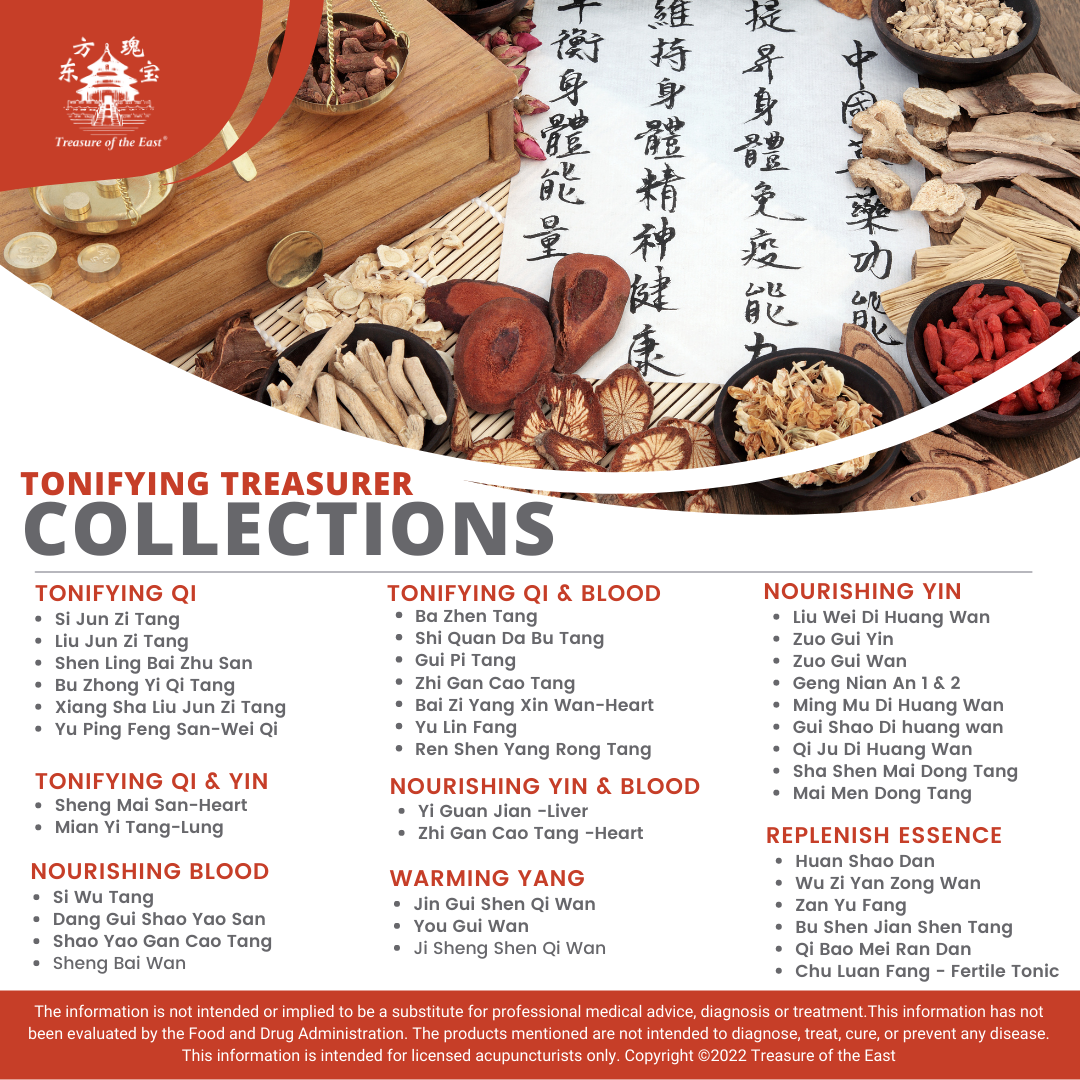
Gui Shao Di Huang Wan - 归芍地黄丸 - Angelica-Paenia-Rehmannia Decoctions (Granules)
Gui Shao Di Huang Wan - 归芍地黄丸 - Angelica-Paenia-Rehmannia Decoctions (Granules)
Couldn't load pickup availability
Not sure this is your formula?
Most people who search a formula name are guessing. Chorus Premium pairs you with a team of Chinese medicine practitioners and a PhD pharmacologist who match the formula to you, check it against your medications, and adjust it as you change.
Full-spectrum, water-based herbal extract; concentrated 5:1 granules (100g/bottle).
Chinese Name: 归芍地黄丸, Gui Shao Di Huang Wan
English Name: Angelica-Paenia-Rehmannia Decoction
Item Number: G050
Formula Principles:
- Nourishes the Liver and Kidneys
- Tonifies Yin and Blood
- Clears Deficiency Heat
Gui Shao Di Huang Wan is a commonly used formula for Fertility Cycle Therapy during the follicular phase (day 6 to day 11) recommended by Dr. Tan, Yong.
Source: Dr. Tan, Yong, is a top fertility expert, she is a professor and Chief Physician at Nanjing University of Traditional Chinese Medicine First Clinical Medical College. She is also the Director of the Gynecology Teaching and Research Department, Director of the Reproductive Medicine Department of Jiangsu Provincial Hospital of Traditional Medicine, and Deputy Director of the National Chinese Society of Traditional Chinese Medicine.
Ingredients:
| Di Huang |
Rehmannia Root |
| Zhu Yu | Cornus Fruit |
| Shan Yao | Dioscorea Rhizome |
| Ze Xie | Alisma Rhizome |
| Mu Dan Pi | Moutan Bark |
| Fu Ling | Poria |
| Dang Gui | Chinese Angelica |
| Bai Shao | White Peony |
TCM Pattern:
- Kidney and Liver Yin and Blood Deficiency
Dosage
Mix 4.5 g in hot water and drink as tea, 2-3 daily.
Full-spectrum, water-based herbal extract; concentrated 5:1 granules (100g/bottle).
Classical source
Classical source
Gui Shao Di Huang Wan is a later member of the Di Huang Wan family. Its base is Liu Wei Di Huang Wan, the six-herb yin formula that the Song dynasty children's physician Qian Yi recorded in Xiao Er Yao Zheng Zhi Jue in 1119. Later physicians added two blood tonics, Chinese angelica and white peony, so that the formula nourishes the blood stored by the Liver as well as the yin of the Kidney. The name lists what was added: gui is dang gui, Chinese angelica; shao is bai shao, white peony; and di huang is the rehmannia pill they join. Wan means pill.
The pattern
The pattern
The pattern is Liver and Kidney yin and blood deficiency (gan shen yin xue kui xu). In Chinese medicine the Liver stores blood and the Kidney stores yin and essence, and the two share a common source, so when one runs low the other follows. The result combines dryness with thin blood. There is dizziness, dry or tired eyes and blurred vision, a sore lower back and weak knees, and sometimes ringing in the ears. Periods are often light, late or scanty, skin and nails are dry, and the limbs can feel numb or cramp at night. Mild heat in the palms and soles may appear. The complexion is pale or sallow, the tongue pale-red with little coat, and the pulse thin. A pale, swollen tongue with cold limbs points to a different pattern.
How it works in Chinese medicine
How it works in Chinese medicine
The treatment principle is to nourish Liver and Kidney yin and build blood. The six-herb base does the Kidney work: rehmannia enriches yin and essence, cornus and Chinese yam hold and steady, and alisma, poria and moutan bark drain and cool so the tonics keep moving. Chinese angelica and white peony are the additions. Angelica nourishes blood and keeps it gently moving, and white peony nourishes Liver blood, softens the Liver and eases cramping. Together they turn a Kidney yin formula into one that also refills the Liver's store of blood. The logic is that essence and blood transform into each other, so both are fed at once.
Ingredients
Ingredients
- Di Huang: Rehmannia root
- Zhu Yu: Cornus fruit
- Shan Yao: Dioscorea rhizome (Chinese yam)
- Ze Xie: Alisma rhizome
- Mu Dan Pi: Moutan bark (tree peony root bark)
- Fu Ling: Poria
- Dang Gui: Chinese angelica root
- Bai Shao: White peony root
Eight plant ingredients, with no animal or mineral substances.
How to use
How to use
The granules are a 5:1 full-spectrum, water-based extract, 100 g per bottle. Mix 4.5 g in hot water and drink as a tea, two to three times daily, or as directed by your practitioner.
If you are pregnant, nursing, taking medication or managing a health condition, speak with your practitioner before use. Educational information only; these statements have not been evaluated by the FDA and this product is not intended to diagnose, treat, cure or prevent any disease.
In biomedical terms
In biomedical terms
In TCM terms this is a shortfall of both blood and yin: too little to moisten the eyes and skin, fill the periods and feed the muscles. Research interprets it mainly as too little steady nitric oxide from the blood vessel lining where oestrogen and blood run low. In healthy women, the oestrogen receptor on blood vessel lining fell by about a third when oestrogen was low, and its level tracked how well the arteries widened and how much endothelial nitric oxide synthase they carried [1]. In young athletes whose periods had stopped, artery widening was the weakest of all groups and improved the most once oestrogen was supplied [2]. Blood itself delivers nitric oxide: red blood cells turn nitrite into nitric oxide as they give up oxygen, opening vessels where tissue needs it [3]. Research interprets thin blood, in TCM terms, as less of this delivery to the hands and feet.
On the herb side, rehmannia and cornus, the core pair of the base, raised butyrate-producing bacteria and faecal butyrate and lifted the gut hormone GLP-1 in studies [4]. Chinese angelica polysaccharide restored oestradiol and anti-Müllerian hormone after ovarian injury, and the gut bacteria it shifted tracked that recovery [5]. Paeoniflorin, the main compound of white peony, raised Lactobacillus and Bifidobacterium [6], and paeonol from moutan bark raised Clostridium butyricum and the short-chain fatty acids it makes [7].
Clinical research
Clinical research
In Chinese practice Gui Shao Di Huang Wan is one of the classical formulas chosen for Liver and Kidney deficiency, and a 2025 review of classical formulas for chronic neck conditions lists it for people whose picture is Liver, Spleen and Kidney deficiency [8].
Questions and answers
Questions and answers
What is Gui Shao Di Huang Wan used for in Chinese medicine?
Gui Shao Di Huang Wan is traditionally used for Liver and Kidney yin and blood deficiency: dizziness, dry or tired eyes, a sore lower back and weak knees, light or scanty periods, dry skin and nails, and numb or cramping limbs at night. It builds on the six-herb Kidney yin formula and adds Chinese angelica and white peony to refill the Liver's store of blood. A practitioner usually confirms the pattern first.
What pattern is Gui Shao Di Huang Wan for?
Liver and Kidney yin and blood deficiency (gan shen yin xue kui xu). Both the cooling, moistening reserve of the Kidney and the blood stored by the Liver are low, so dryness and thinness show together. Typical signs are a pale-red tongue with little coat and a thin pulse. Where heat dominates, with a red tongue and strong night sweats, or where cold and a pale, swollen tongue dominate, a different formula is usually chosen.
How does Gui Shao Di Huang Wan work?
In Chinese medicine terms, the rehmannia base replenishes Kidney yin while Chinese angelica and white peony nourish Liver blood. In biomedical terms, research interprets the pattern as too little steady nitric oxide from the blood vessel lining where oestrogen and blood run low [1] [3]. In studies its herbs shifted the gut flora: the rehmannia and cornus pair raised butyrate producers [4], and paeoniflorin from white peony raised Lactobacillus and Bifidobacterium [6].
What is the difference between Gui Shao Di Huang Wan capsules and granules?
Both are 5:1 full-spectrum, water-based extracts of the same eight herbs from the same maker. The granules dissolve in hot water and are drunk as a tea, which makes the amount easy for a practitioner to adjust. The capsules hold the same kind of extract in a portable, tasteless form, 100 capsules per bottle. Follow the label or your practitioner for how much to take.
Who should not take Gui Shao Di Huang Wan?
Check with a practitioner first if you are pregnant or breastfeeding, take blood-thinning or other prescription medication, or manage a health condition. Traditionally the formula is not used when digestion is weak with loose stools and a poor appetite, or when the tongue coat is thick and greasy, since the rich, nourishing herbs can sit heavily. It is also not the choice during a fever or a sudden acute illness.
How long does Gui Shao Di Huang Wan take to work?
In Chinese medicine, blood and yin are rebuilt slowly, so practitioners usually judge a nourishing formula like this over several weeks, and often across two or three menstrual cycles when periods are part of the picture. If nothing has changed after several weeks, it is worth asking whether the pattern was the right match, or whether heat, cold or stagnation also needs attention.
References
References
- Gavin KM et al. (2009). Vascular endothelial estrogen receptor alpha is modulated by estrogen status and related to endothelial function and endothelial nitric oxide synthase in healthy women. J Clin Endocrinol Metab. PubMed
- Rickenlund A et al. (2005). Oral contraceptives improve endothelial function in amenorrheic athletes. J Clin Endocrinol Metab. PubMed
- Crawford JH et al. (2006). Hypoxia, red blood cells, and nitrite regulate NO-dependent hypoxic vasodilation. Blood. PubMed
- Chen Y et al. (2022). The Herb Pair Radix Rehmanniae and Cornus Officinalis Attenuated Testicular Damage in Mice With Diabetes Mellitus Through Butyric Acid/Glucagon-Like Peptide-1/Glucagon-Like Peptide-1 Receptor Pathway Mediated by Gut Microbiota. Front Microbiol. PubMed
- Wu M et al. (2025). Protective effects of Angelica sinensis polysaccharide on chemotherapy-injured rats with premature ovarian insufficiency and its impact on gut microbiota. Front Pharmacol. PubMed
- Xia M et al. (2025). Paeoniflorin improves atherosclerosis by regulating the gut microbiota and fecal metabolites. mSystems. PubMed
- Zhao M et al. (2023). Paeonol alleviates ulcerative colitis in mice by increasing short-chain fatty acids derived from Clostridium butyricum. Phytomedicine. PubMed
- Chen H et al. (2025). [Cervical spondylosis: innovative understanding from traditional Chinese medicine and treatment by classic formulas]. Zhongguo Zhong Yao Za Zhi. PubMed
Share